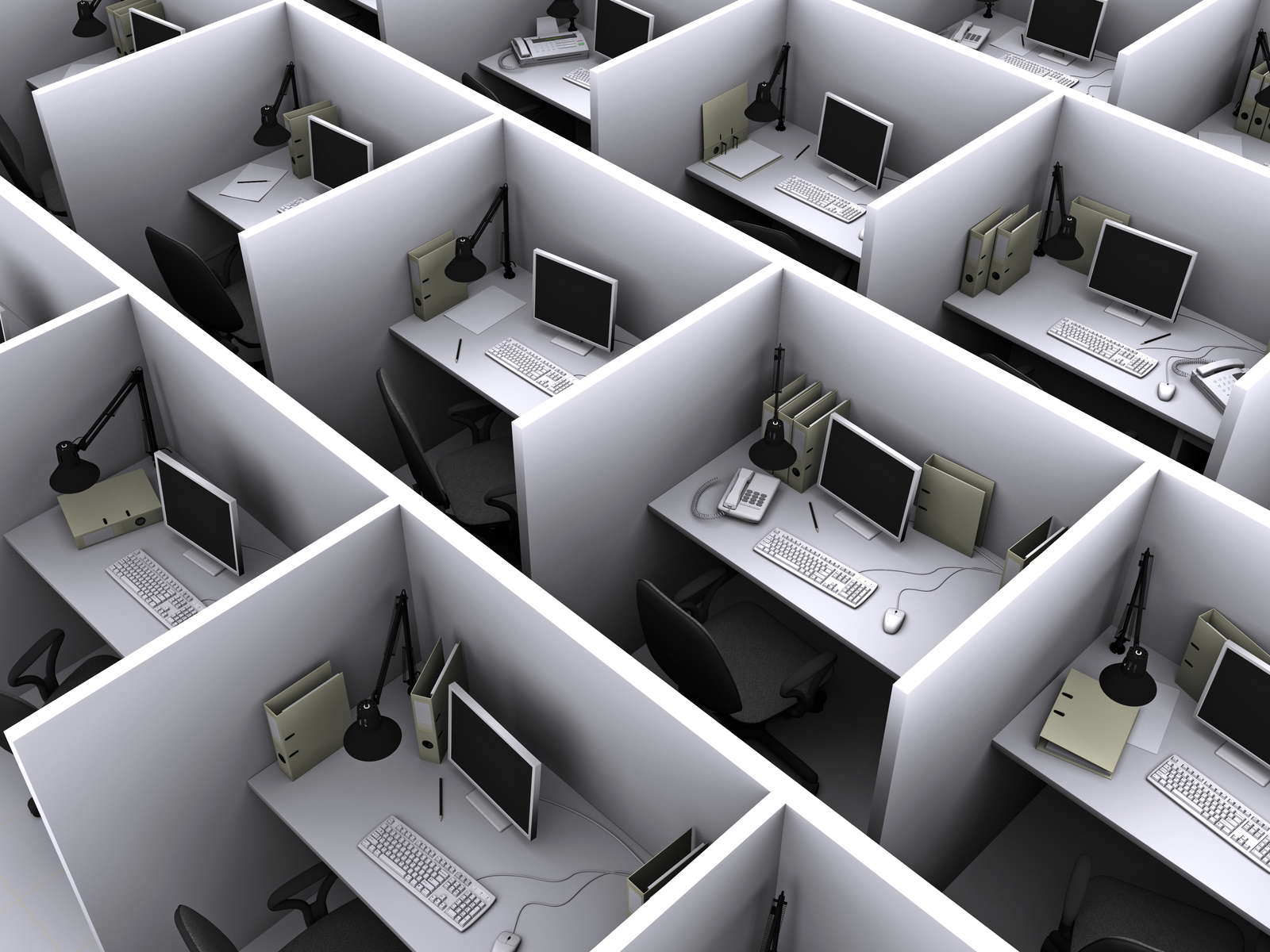

Employees with cognitive impairments may experience a variety of difficulties when performing job duties in a cubicle environment. These impairments may be temporary or permanent and may affect overall work performance, including quality of work, conduct, and productivity.
The following describes potential issues that employees with cognitive impairments may face when working in a cubicle environment, some preventative measures the employer can take to minimize difficulties, and accommodations that can be made for employees who have cognitive impairments.
Cognitive impairments may be a result of one or more of the following conditions: Attention deficit disorder or attention deficit hyperactivity disorder, Asperger syndrome, bipolar disorder, brain aneurysm, cancer, chronic fatigue syndrome, depression, epilepsy, fibromyalgia, head injury, learning disability, migraine headache, ID/DD, multiple sclerosis, post-traumatic stress disorder, sleep disorders, and stroke. Other conditions may also result in short- or long-term cognitive limitations. JAN receives many calls asking for accommodation ideas to assist these individuals with performing their job activities in cubicle environments. The following is a summary of these ideas.
1. Employees with cognitive impairments may experience disorganization in their cubicles. This is due, in part, to the compressed work and storage space of a cubicle, which may not be used efficiently or effectively. Setting up files, labeling and organizing work materials, and stocking the workstation with necessary supplies can help employees be more organized.
2. Employees with cognitive impairments may be easily distracted by auditory and visual stimuli. Consider strategic placement of workspaces, e.g., at the end of a row so only one wall is shared with other workspaces. Placing a workspace in a low-traffic area, away from the path to the bathroom, the building's exit, or office equipment can also be helpful. To avoid further auditory distraction, consider placing the workspace away from active areas like the lunchroom, meeting tables, or the copy center. If it is not possible to move the workspace, consider modifying the workspace by purchasing taller cubicle walls, adding cubicle doors, adjusting the position of the desk or chair, providing sound absorption panels, and/or providing a white noise machine.
3. Employees with cognitive impairments may have difficulty managing time, due in part to everyday workplace distractions. Providing noise-canceling headsets may help employees stay focused on the task at hand. The use of timers or watches will be helpful and assist with time management and task completion. An electronic organizer can also be valuable, keeping track of scheduled events and deadlines and providing graphic or audible alarms to prompt moving to the next job task or activity.
4. Employees with cognitive impairments may have difficulty engaging in work-related communication in a cubicle environment. Cognitive impairments can result in poor impulse control, poor judgment, or lack of social skills that create communication problems. These problems can include talking too loud or striking up conversations in the wrong place or at the wrong time. Setting clear rules for communication in/around cubicle spaces that regulate voice control, duration of work or private conversations, and disciplinary actions will help control noise levels, avoid congregations of chatty employees, and extinguish behavior such as calling out over cubicle walls.
5. Employees with cognitive impairments can experience disorientation, which may result in not knowing where to find people, materials, or services in a cubicle environment. It may be difficult to get to public-use areas such as the bathroom, copy room, or conference tables. Offering to show where materials can be found or where places are located, and/or provide verbal, written, or pictorial instructions could also be useful.
6. Employees with cognitive impairments may need to control the temperature in a cubicle environment. Adjusting temperature can increase productivity by reducing distractions and providing consistent physical comfort in the workplace. Allowing personal heating devices or personal cooling devices may also be helpful, as the employee will be less likely to fall asleep, leave work early due to discomfort, or lose work-time because he/she is unfocused or uncomfortable.
7. Privacy is an issue in a cubicle environment for all employees, including those employees with cognitive impairments. An employee might be self-conscious about using accommodations such as speech recognition software or screen reading software. The use of a headset will allow only the employee to hear what is being read from the screen reader. The use of a voice-amplifier will allow the employee to whisper while using speech recognition software. Another option is to use a steno system, which allows individuals to use speech recognition software while talking into a mask. This mask prevents others from hearing what is being said. Designating a private area so that the employee can call job coaches, therapists, or other people in their support system may also be beneficial.